

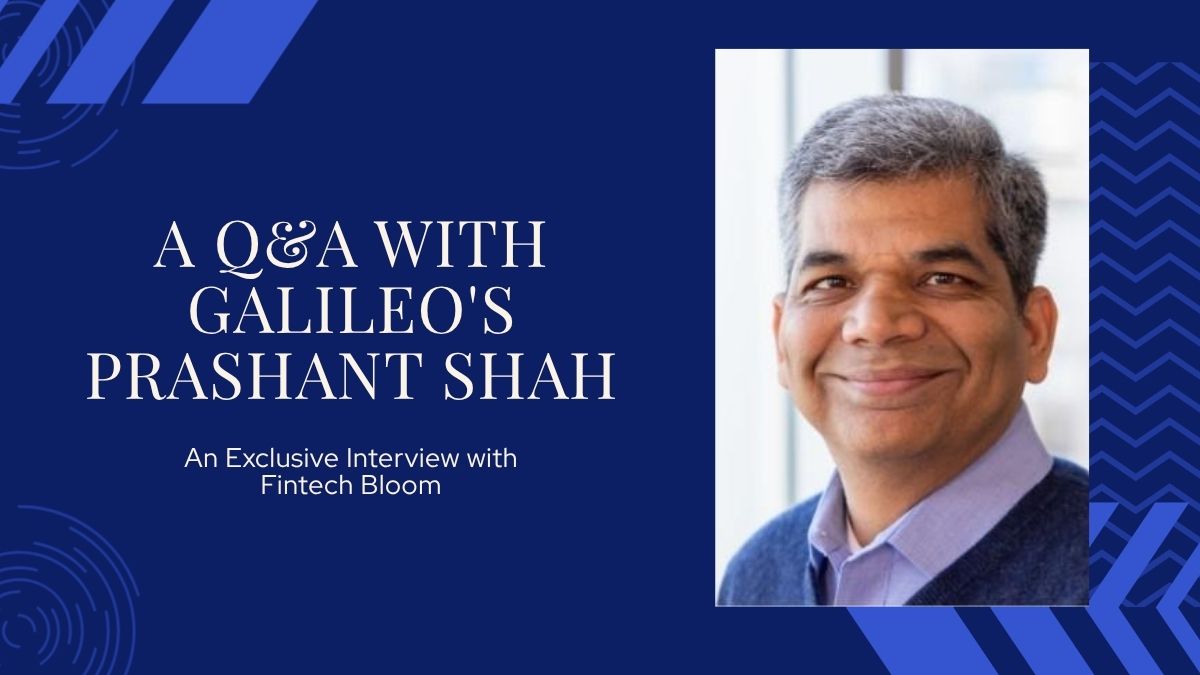
Interview with Prashant Shah, VP of Product Management Galileo Financial Technologies
1. Embedded finance has been discussed for years, but recent research suggests the industry is entering a fundamentally different phase. What has actually changed in the embedded finance landscape and why does it matter more now than ever before?
Embedded finance is about more than adding a card to an app or a checkout button. It’s about helping brands build connected sets of financial products inside their own ecosystems so customers can pay, get paid, earn rewards and access financial tools without being pushed into a fragmented experience outside the brand relationship.
In Galileo’s research, brands say they plan to launch an average of just over three integrated financial services, including options like co-branded cards, faster payouts and payroll-linked accounts.
That matters because it reflects how consumers are already behaving. They’re building their own mix of payment tools across debit, credit, BNPL, rewards cards, and digital wallets and they’re increasingly managing their money through the apps and brands they use every day. Our research shows 41% of consumers have used a digital wallet inside a shopping, travel or food-delivery app and 27% have redeemed rewards as cash at checkout. Brands that ignore these trends risk losing customers to competitors that make checkout easier.
2. There is a growing argument that every company is becoming a financial interface rather than a bank. Is embedded finance for non-financial brands a realistic trajectory for most businesses, or a strategy reserved for a select few?
Not every company needs to look or act like a bank. But more companies are becoming part of people’s everyday financial lives.
Integrated financial services are for businesses that have repeat engagement, meaningful transaction volume, and clear moments where money needs to move—whether that’s payments, refunds, rewards, financing, or payouts. When those conditions are in place, embedding financial services stops being a nice-to-have and becomes a way to deepen relationships, unlock new revenue, and control more of the customer experience. It’s no longer just the domain of tech giants; insurance carriers, healthcare networks, payroll providers, gig platforms, and even mid-sized retailers already have everything they need to play this role.
Our research shows that 20% of brands have already launched integrated financial services, and the remaining 80% plan to do so in the next 12 to 18 months. They’re using these programs to acquire new customers, drive core product sales, generate ancillary revenue, improve the customer experience, and keep existing customers. Within that group, 28% say they are in “crisis mode” and must launch as soon as possible, and another 27% report “high urgency” to launch within 12–18 months.
3. Your research highlights customer retention and operating model transformation as the real drivers behind embedded finance adoption. Why has the narrative taken so long to move beyond embedded payments and checkout experiences?
Checkout was the easy first chapter. It’s simple to explain, easy to measure, and gives brands a clean ROI story around reducing friction and improving conversion.
Once spending started moving further into brand apps and digital wallets, it became easier to see how saved payment methods, integrated rewards, instant refunds, and branded card or debit experiences can influence repeat engagement and long-term loyalty. Our research shows 20% of consumers say they buy more often from a brand after saving a payment method in its app, 18% say they spend more overall, and 63% say faster, frictionless payments make them more likely to keep using that app.
4. Demand for embedded financial services clearly exists but trust is emerging as the next major challenge. Where is the consumer trust gap most acute, and who is ultimately responsible for closing it?
The data shows comfort is highest when value is immediate and obvious: 54% say they’re comfortable accepting an instant refund inside a brand app and 53% are comfortable receiving direct deposit from a brand. At the same time, 27% worry about their card or bank details being stolen and 17% worry about how their data gets used. Comfort with instant refunds, checkout, and direct deposits suggests trust is strongest when the benefit is tangible and the experience feels familiar.
The same person can be enthusiastic about one financial feature and cautious about another inside the same app.
From the customer’s point of view, the brand owns that experience. They’re not separating the logo on the screen from the bank or platform behind the scenes. If something goes sideways, they blame the brand. That means brands need to design for trust directly in the product — clear disclosures, transparent consent, visible protections, reliable resolution paths — while choosing partners that can manage the operational compliance and risk complexity underneath. In our research, 62% of executives told us they want partners to assume risk and liability for compliance, fraud and operations.
5. Regulation is frequently framed as a barrier to embedded finance growth. Do you view it more as a constraint or a strategic opportunity and how should product leaders be approaching compliance in 2025 and beyond?
Compliance, fraud, and operational complexity are not easily brought in‑house. The right platform can shoulder the critical risk so the brand can focus on product design, customer experience, and distribution. Programs that build in governance, iteration, and measurement from day one are far more likely to scale — and less likely to stall out because of internal misalignment or regulatory surprises.
In our research, 42% of executives said they want clearer regulatory guidance, especially for regulated flows like disbursements, benefits and earned wage access.
6. Banking-as-a-Service platforms that support bundled financial experiences are emerging as the long-term winners. What does a genuinely bundled embedded finance experience look like in practice and what infrastructure does it require?
A genuinely bundled experience feels simple to the customer, even though a lot is happening behind the scenes. Someone can pay with a card, keep it in a digital wallet, earn and redeem rewards, get fast payouts or refunds, and access savings or financing options — all inside one brand experience, with one login and a single view of their financial transactions with that brand.
That kind of experience requires an infrastructure that supports multiple financial products on one platform, not a stack of point solutions. At the core is a modern ledger that can represent different types of balances and obligations with shared controls for risk, reconciliation and compliance, plus a real-time data layer that uses context to trigger actions like real-time rewards redemption at point of sale, which 61% of brands told us they want.
If every new feature requires stitching together another vendor and another dataset, the experience stops feeling seamless and operations become fragile. Platforms that bring accounts, payments, cards, rewards and credit together on a single, programmable platform give brands the ability to design truly bundled experiences.
7. For every embedded finance success story, there are quiet failures that rarely make headlines. What are the most common mistakes brands make when integrating financial products and what do those failures teach the broader industry?
One of the biggest mistakes is treating a single product launch as a full strategy. A co-branded card or single wallet feature is a good start but there’s an opportunity to keep layering on new features. Our research shows brands are planning just over three integrated financial services on average. Scalable programs are built as connected roadmaps that grow with their customers, not one-off launches.
Another common mistake is underestimating the behind-the-scenes part of the experience: refunds, disputes and support. Those moments may feel back-office, but they have a direct impact on loyalty. Our research shows 50% of consumers have switched brands because paying or getting a refund was easier elsewhere. The refund flow is the loyalty flow. Customers remember who made it easy to pay and get paid.
8. Where does embedded finance go from here? And what should founders, CPOs, and product executives be prioritising today to stay ahead of the curve in an increasingly competitive embedded finance market?
The next phase is about making integrated financial services part of the product itself, not add-on features. Everyday spend continues to move into brand apps and digital wallets, and customers are quick to change how they pay when it’s more convenient, rewarding or valuable.
For founders and product leaders, three priorities stand out. First, identify the money moments in the customer journey that create the most friction — paying, getting paid, getting a refund, accessing rewards — and make those simple and reliable before you do anything else. Second, choose a partner that lets you keep adding new payment, deposit, rewards, or credit features over time without rebuilding your foundation each time.
Third, make sure the infrastructure can support real-time, data-driven experiences as expectations rise. 61% of brands told us they’re interested in real-time rewards redemption at point of sale and 29% in AI agents. That’s where the edge will come from.
The window for first-mover advantage is real, but it’s closing. 80% of brands are still in planning mode. The ones who ship in the next 12 months get to set the customer expectations everyone else has to match.
About Prashant Shah:
Prashant Shah has an extensive work experience spanning over two decades. Prashant currently holds the position of VP of Product Management at Galileo Financial Technologies, starting from April 2022. Prior to this, they served as a Senior Director of Product Management at PayPal from July 2021 to April 2022. Prashant also held the position of Director of Product Management at PayPal from March 2020 to June 2021. Before joining PayPal, Prashant worked at Braintree as a Lead Product Manager from S1eptember 2015 to February 2020.