


By Rustam Bagautdinov, Director of Processing at Payzon
Most industry discussions surrounding the evolution of digital wallets tend to focus on the surface: consumer adoption metrics, conversion uplift at online checkouts, transit gate latency, and the ongoing UX polish delivered by Apple, Google, and Samsung. By all visible measures, Big Tech has won the battle for the consumer interface. A single biometric tap or facial recognition scan now orchestrates payments across millions of point-of-sale terminals and mobile apps worldwide.
However, from an engineering and settlement perspective, the prevailing narrative is misleading. Mobile wallets in Western markets are not independent payment networks; they are sophisticated virtualization layers wrapped around half-century-old card scheme architectures. Every time an iPhone or Android device taps a contactless terminal, the underlying transaction still triggers a familiar, fragmented four-party model: traversing merchant acquirers, card networks, token service providers, issuer host processors, and batch-settled core banking databases.
This architectural compromise is reaching its economic and technical limits. As interchange fees face tightening regulatory caps, issuer margins compress, and sovereign authorities accelerate work on real-time account-to-account (A2A) rails and Central Bank Digital Currencies (CBDCs), the real competitive battleground is shifting away from the mobile screen. The next five to seven years of digital wallet innovation will not be defined by who controls the operating system front-end, but by who engineers the processing, tokenisation, and settlement core beneath it.
Tokenisation Pipeline & Issuer Ledger Overhead
To understand why the current wallet paradigm is straining, one must look at the data flow executed during a standard tokenised transaction. When a user provisions a plastic card into Apple Pay or Google Wallet, the Primary Account Number(FPAN) is never stored on the physical device. Instead, the device requests a Device Primary Account Number (DPAN) via a Token Requestor interface, which coordinates with a Token Service Provider (TSP) – primarily Visa Token Service (VTS) or Mastercard Digital Enablement Service (MDES) – and the issuing bank’s host system.
During authorization, the Secure Element or Host Card Emulation (HCE) environment generates a dynamic, transaction-specific cryptogram (such as a dynamic CVV or EMV cryptogram). This payload travels upstream through the acquirer to the scheme, where the TSP de-tokenises the DPAN back into the underlying FPAN before routing the ISO 8583 authorization payload or ISO 20022 settlement message to the issuing bank’s core processing engine.
While this structure has drastically reduced card-present fraud, it has introduced substantial operational friction and structural asymmetry for commercial banks:
- Token Lifecycle Complexity: Issuers are forced to maintain complex, stateful token lifecycle systems. A single bank account may now have dozens of active DPANs distributed across multiple watches, phones, merchant subscriptions, and browser vaults. Managing concurrent states – token suspension, device revocation, card replacement updates, and key rotation – places continuous processing loads on issuer infrastructure.
- Economic Asymmetry: Big Tech operating systems extract a fee per transaction (typically a fixed basis-point cut of interchange) simply for presenting the tokenized credentials at the point of sale. Meanwhile, the issuing bank bears the entirety of credit exposure, capital reserve requirements, chargeback handling, fraud liability, and core database maintenance.
- Network Fees and Margin Compression: With the Payment Systems Regulator (PSR) in the UK, the European Commission, and global regulators continually reviewing interchange structures and scheme fees, banks find their unit economics squeezed. They are paying for scheme tokenisation routing while supporting legacy core infrastructure that was never architected for continuous, high-velocity micropayment throughput.
In short, banks have outsourced the customer relationship to phone manufacturers while retaining all the operational costs and settlement liabilities of legacy clearing.
Western Card-Proxy Model vs. Asian Direct Settlement
The primary limitation of Western mobile wallets stems from their legacy lineage: they were designed as proxies for plastic credit and debit cards. By contrast, leading digital wallet ecosystems across Asia and Latin America bypassed card infrastructure entirely, building direct settlement networks connected to central bank rails or proprietary closed-loop ledgers.
Consider the architectural divergence:
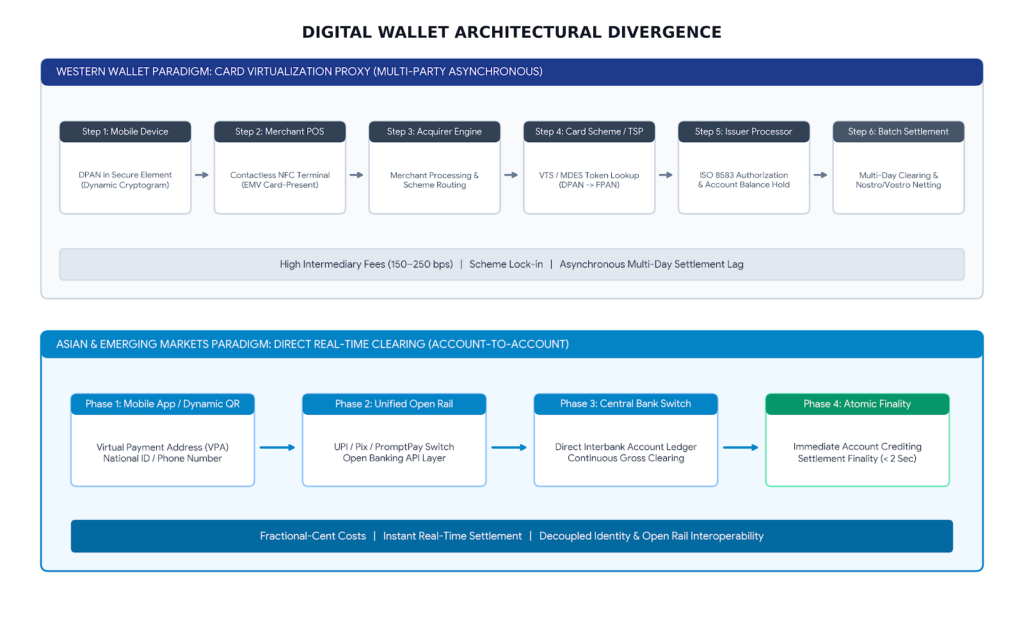
In markets such as China (Alipay and WeChat Pay), India (UPI), Brazil (Pix), and Thailand (PromptPay), the wallet does not act as an EMV container. It functions as an intuitive addressing and routing client communicating directly with an account-based instant settlement switch.
The structural advantages of this approach are decisive:
- Interchange Elimination: By bypassing the card network interchange apparatus, transaction clearing costs drop from 150–250 basis points down to fractions of a cent per transaction.
- Instant Finality: Merchant funds do not sit in multi-day rolling reserve queues or await overnight batch clearing. Settlement is gross, continuous, and immediate.
- Decoupled Identity: Addressing relies on phone numbers, national tax IDs, or virtual payment addresses (VPAs), fully decoupling payments from vulnerable 16-digit card sequences.
Western payment architectures are now feeling the pressure of this divergence. With the roll-out of SEPA Instant in Europe, the operational maturing of the UK’s Faster Payments (and the New Payments Architecture roadmap), and the expansion of FedNow in the United States, digital wallet backends must inevitably transition from card virtualization engines into multi-rail, real-time routing platforms.
CBDC and Programmable Ledger Integration Gap
The most profound architectural challenge facing mobile wallets over the coming decade is the convergence of commercial banking deposits, wholesale/retail CBDCs, and tokenised assets.
Almost all major central banks – including the Bank of England (Project Rosalind), the European Central Bank (Digital Euro), and the Bank for International Settlements (BIS Project Agorá and Project mBridge) – are actively testing sovereign programmable money. However, integrating these assets into commercial digital wallets exposes a severe technical impedance mismatch.
Today’s digital wallet architectures operate entirely on message-passing semantics. A transaction is an instructional signal sent across networks, resulting in out-of-band double-entry accounting adjustments in decoupled relational databases.
By contrast, CBDCs, tokenised deposits, and regulated stablecoins operate on state-transition semantics. In a distributed ledger or unified programmable ledger environment, payment instruction, FX conversion, and settlement finality are fused into a single atomic execution block. There is no separate “clearing” phase – transferring the token is the settlement.
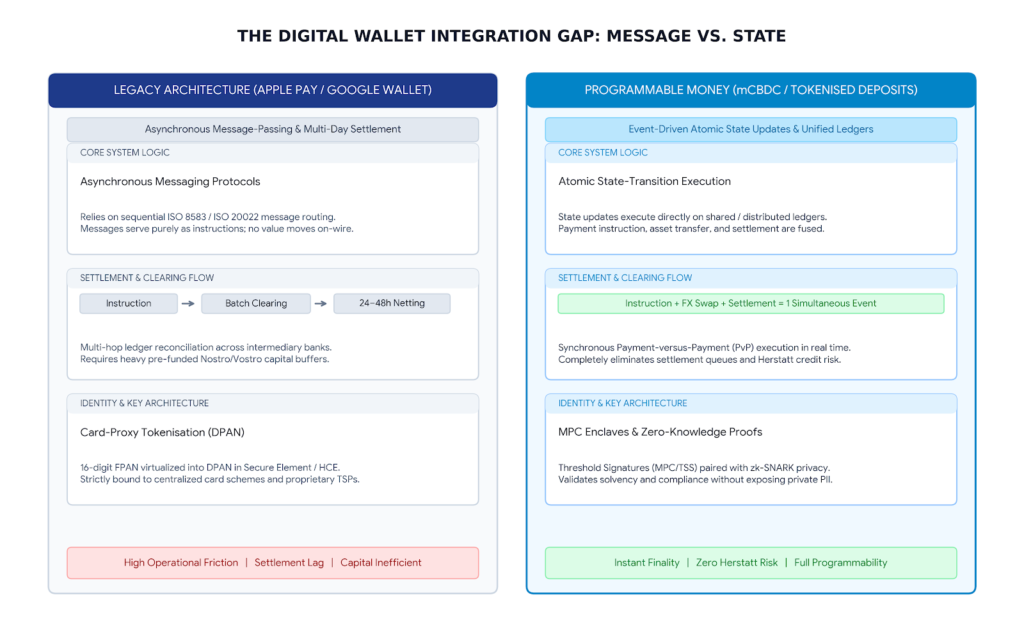
This divide creates major architectural bottlenecks for wallet issuers and processing engineers:
- Secure Element Cryptographic Compatibility
Mobile device Secure Elements and Apple/Google payment applets are hardwired for classical cryptographic standards – primarily RSA and elliptic curves like NIST P-256 for EMV cryptogram generation. Many modern tokenised deposit networks and blockchain protocols rely on secp256k1 or Ed25519 curves, or require Multi-Party Computation (MPC) signing enclaves. Bridging this without compromising the hardware security boundaries of the smartphone is an ongoing engineering challenge.
- Offline Functionality and Double-Spending
Card payments rely on offline data authentication (ODA) backed by issuer risk limits and post-facto chargebacks. A digital cash equivalent or CBDC held in a wallet must prevent double-spending entirely offline, without reaching a central validator. This requires hardware-enforced unspent transaction output (UTXO) counters inside the handset’s trusted execution environment – a standard that consumer device manufacturers have yet to open fully to third-party commercial banks.
- Privacy vs. Programmable Compliance
While consumers demand the privacy of physical cash, regulators mandate stringent AML and Travel Rule verification. Wallets interacting with programmable ledgers cannot publish raw user balances or transaction data to shared validators. Processing engines must therefore implement off-chain identity vaults coupled with on-chain Zero-Knowledge Proofs (zk-SNARKs), allowing wallets to prove solvency, age, and sanction-screening compliance without leaking transaction telemetry to the network.
Strategic Blueprint: The Next-Generation Wallet Processing Core
As card rails become just one of many clearing options, the backend architecture supporting digital wallets must undergo a modular redesign. Future-ready transaction engines will need to operate as multi-rail orchestration hubs capable of dynamic routing across cards, instant A2A systems, and programmable token ledgers.
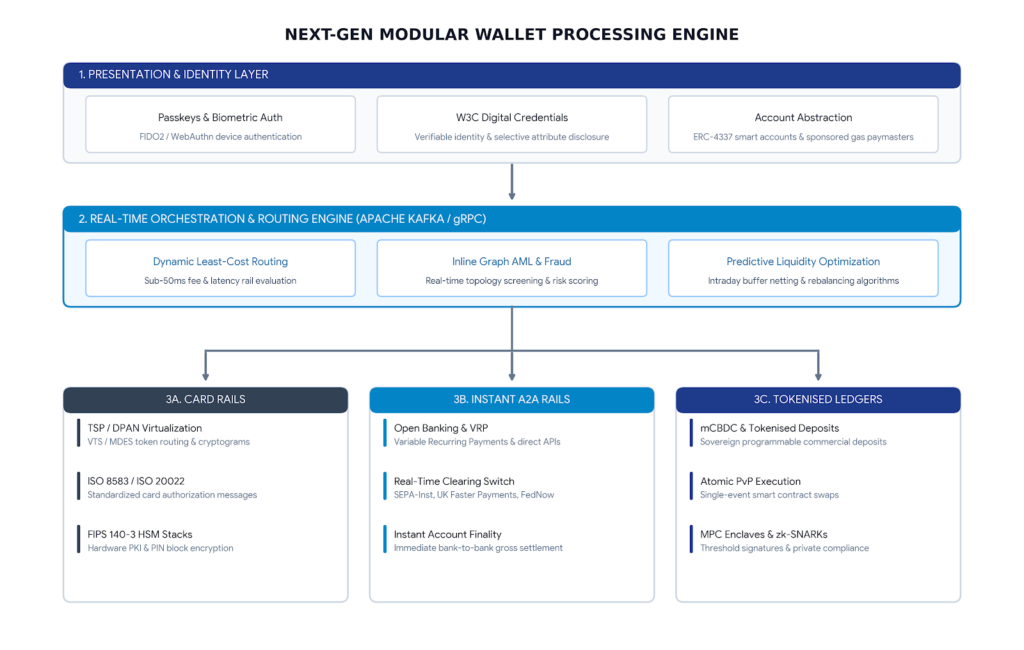
To build a processing infrastructure capable of supporting this transition over the next five years, architects should anchor development around four core capabilities:
- Decoupled, Multi-Rail Routing Engines: Authorization cores must evaluate incoming payment intents in sub-50ms, dynamically routing between legacy card schemes, domestic instant accounts (via Variable Recurring Payments or FedNow), and tokenised deposit rails based on fee optimization, merchant acceptance, and real-time liquidity availability.
- Dual-Regime Cryptographic Key Management: Financial institutions must operate hybrid cryptographic infrastructures. This requires running certified FIPS 140-3 HSM modules for legacy EMV PIN and ISO message signing alongside MPC (Multi-Party Computation) key enclaves for threshold signatures on distributed ledgers.
- Account Abstraction & Sponsored Smart Transactions: For non-custodial and programmable wallet flows, systems should implement account abstraction standards (such as ERC-4337 mechanisms). This permits centralized paymasters or merchants to sponsor gas and network fees, allowing consumers to transact in commercial bank tokens without managing underlying network complexities.
- Embedded Event-Driven Compliance: Compliance screening must move away from post-transaction batch monitoring. Transaction processors must embed graph analytics and automated zero-knowledge credential checks directly into the inline execution pipeline, validating KYC and sanction parameters before state finality occurs.
Reclaiming the Processing Core
The assumption that digital wallets belong exclusively to Big Tech overlooks the reality of payment plumbing. While technology giants have captured consumer presentation habits, they remain entirely dependent on the underlying financial rails to clear, settle, fund, and underwrite every single interaction.
As settlement rails transition from batch-oriented card proxies to instant, programmable architectures, the balance of power will reset. The institutions that thrive in the next decade will not be those attempting to build copycat smartphone front-ends, but those that overhaul their core processing engines – bridging traditional ISO messaging, high-speed domestic A2A networks, and atomic token settlement into a unified, high-performance orchestration layer.
The mobile wallet is no longer just a digital pocket for plastic cards; it is rapidly becoming the client interface to a real-time, programmable global financial ledger.
Author Bio:
Rustam Bagautdinov is the Director of Processing at Payzon, specialising in high-load transaction switching architectures, card scheme infrastructure, and real-time settlement rails. Across his career in Europe and the MEA region, he has contributed to developing and implementing mission-critical systems and integrations for Tier-1 banking institutions and major payment processing hubs. His focus centers on tokenisation frameworks, resilient gateway design, and bridging legacy card schemes with next-generation programmable settlement models.