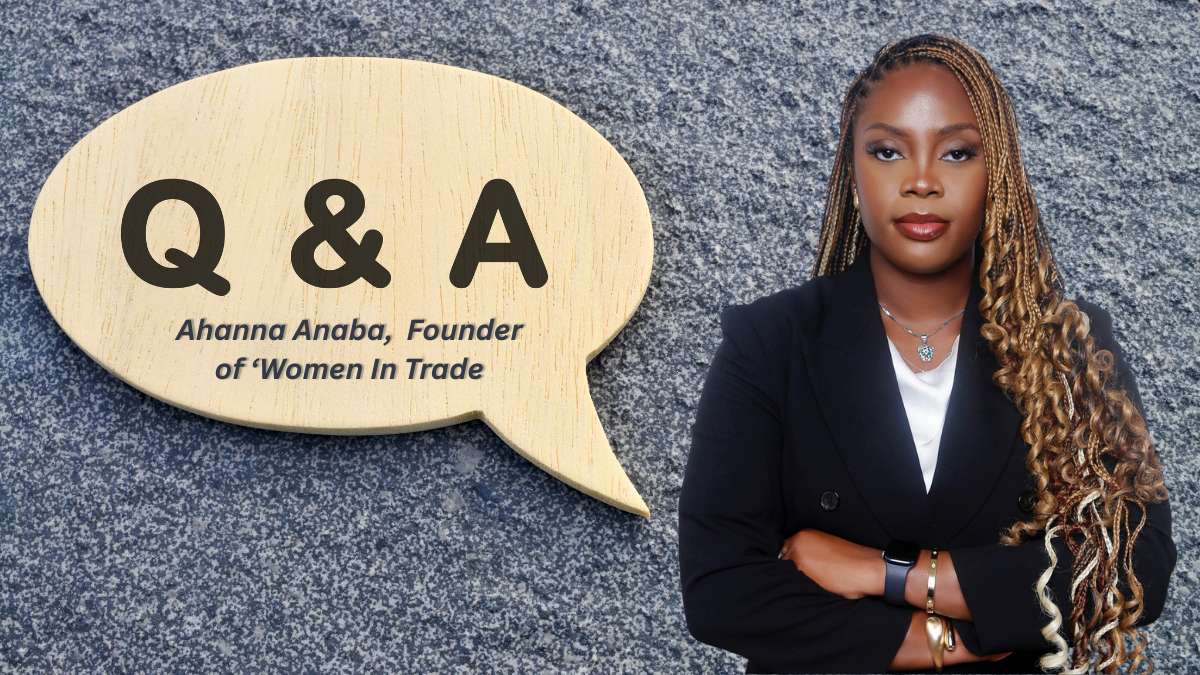
A Q&A with Ahanna Anaba, 2025 Black British Business Awards finalist in the Financial Services category and Founder of ‘Women In Trade, on why practitioner-led, women-focused networks are not “diversity initiatives,” but strategic levers for better product design, faster adoption, and sustainable growth in trade finance and fintech.
Q: Trade finance remains one of the most complex and under-digitised areas of financial services. From your experience, what was missing in the ecosystem that prompted you to launch the Women in Trade Network?
A: Trade finance is still built around closed circles. It’s relationship-driven, highly specialised, and senior roles remain male-centric, even more so than in finance more broadly.
I would regularly meet women working in trade-related roles inside banks and institutions, but I rarely saw them at conferences, industry events, or on panels. It wasn’t a lack of interest or capability. It was access to the industry spaces where people meet clients and partners, exchange market intelligence, and stay close to how the market is evolving.
The Women in Trade Network was created to surface that expertise and connect women working across trade finance, particularly across African markets where ecosystems are fragmented and relationships matter even more. Today, the network brings together over 600 senior women across more than 16 countries.
Q: Many banks and fintechs today are prioritising technology and technical skills, but you often talk about domain expertise as a competitive advantage. Why does this matter so much in trade and transaction banking?
A: Digitising trade has been the agenda for as long as I can remember, but the progress has been slow. Digitisation isn’t the problem. The challenge is that a lot of digital tools are still implemented without a deep understanding of how trade actually works in practice for the many people in the process.
Trade finance sits at the intersection of credit, risk, operations, legal, compliance, and client behaviour. If you don’t understand where friction really sits, how decisions are made inside banks, or how transactions behave across different market realities, technology alone won’t fix it.
This is where domain expertise is an edge for people who don’t have the technical background but want to be involved in the digitisation conversation. Domain expertise matters because it anchors digitisation in reality, and it comes from experience. The tools that gain traction are the ones that reflect how practitioners actually work, not how trade should ‘ideally’ work.
Q: What does community-led insight look like in practice, and what do banks and fintechs tend to underestimate when designing trade finance solutions?
A: It brings reality into the design process much earlier.
When practitioners are engaged early, you see where processes actually break down, what workarounds people rely on, and what clients are genuinely willing to change. You also see where digitisation adds value and where it introduces friction or new risk. This is especially powerful when that insight reflects the changing profile of the people working in trade finance today.
This matters because trade finance is inherently messy. It cuts across formal and informal systems at the same time. And in many markets, experienced trade talent is thinning out. Most products are still designed with an idealised customer at the top of the pyramid and struggle to scale down.
Practitioner-led insight is what prevents teams from building in isolation. It grounds digitisation in how trade actually works across different markets and reduces the gap between what gets built and what actually gets used.
Q: Inclusion is often framed as values-led. How does it actually impact business performance?
A: Once you strip away the bias, inclusion is simply better judgment. It’s choosing to use all the perspectives available to you.
The people designing and running trade products today are dealing with a very different customer base than they were twenty years ago. Counterparties have changed, operating environments are more complex, constraints are tighter and markets are increasingly more volatile and unpredictable. When decision-making reflects a broader set of experiences, assumptions get challenged earlier, and blind spots are easier to catch.
That leads to more realistic risk assessment and, ultimately, products and services that are better suited to how clients actually operate. The commercial impact is clear: deeper client relationships, a more nuanced understanding of opportunity, more diverse strategies, and growth that is more resilient in today’s environment.
It’s more than values. It’s about being smart in how you build offerings that can hold up in real markets.
Q: As trade finance digitises, what role do you see networks like Women in Trade playing in the next phase of innovation?
A: Networks will matter more, especially as the world becomes more digital.
Trade finance has traditionally been learned through proximity. Who you sit next to, who explains how things really work, who brings you into conversations you wouldn’t otherwise have access to. Women-led networks help replicate that access by connecting practitioners across institutions and markets, allowing experience to be shared rather than relearned in isolation. That matters for progression, retention, and building long-term expertise in the sector.
For trade finance more broadly, the impact is structural. As the industry digitises, product design and decision-making will increasingly be shaped by who is in the room early. Networks like Women in Trade help ensure that the people feeding into that process reflect the reality of today’s market, not just its historical profile.
The result is a deeper and more diverse pool of experienced practitioners, faster circulation of valuable insights, and better-informed decisions. That’s how trade finance evolves in a way that is both commercially viable and fit for the markets it serves.