

By Jonathan Brown, Director, GWCU
Every Company is Becoming a Fintech Company
Over the past decade, financial services have quietly begun migrating away from traditional banks and into the infrastructure of everyday digital platforms. What began with embedded payments inside e-commerce platforms has now evolved into a broader transformation: companies with large customer bases are increasingly integrating lending, remittances, insurance, and other financial products directly into their user experience.
This shift, commonly referred to as embedded finance, is redefining how financial services are distributed. Rather than requiring customers to seek out standalone banking relationships, financial functionality is increasingly delivered natively within platforms they already use daily.
From ride-hailing apps offering driver financing to marketplaces providing working capital to merchants, the core pattern is consistent: distribution is becoming more valuable than the financial product itself.
One of the most structurally advantaged distribution channels in emerging markets is the telecommunications sector.
Why Telecom Companies Are Uniquely Positioned
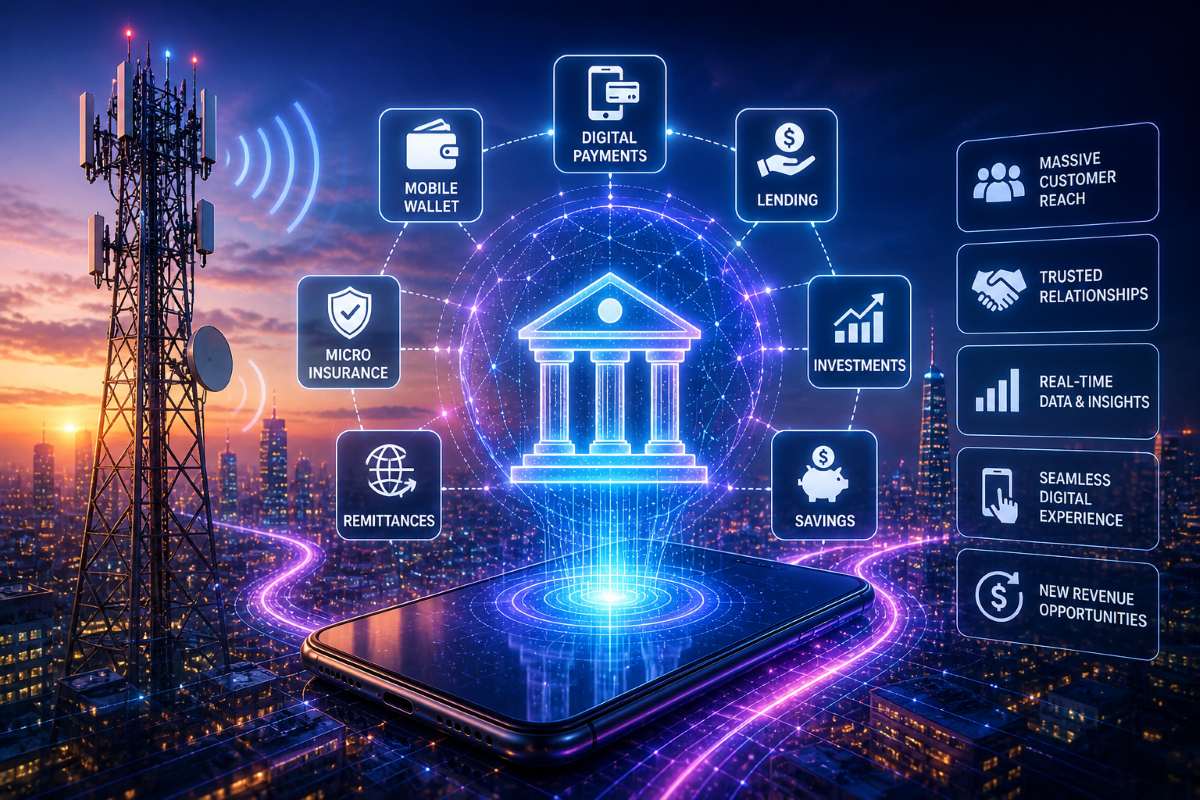
Telecommunications companies sit at the intersection of identity, payments, and behavioral data. They maintain ongoing billing relationships with millions of users, have deep insights into customer activity patterns, and operate trusted infrastructure that customers engage with frequently.
In many markets, particularly across Africa and parts of Asia, mobile network operators have already built extensive financial ecosystems through mobile money services. These platforms allow users to store value, transfer funds, and pay for services without requiring traditional bank accounts.
This infrastructure provides a natural foundation for the expansion of embedded financial services beyond payments into areas such as credit, asset financing, and cross-border remittances.
Telcos possess three structural advantages:
1. Distribution at scale
Telecommunications providers often serve tens of millions of customers, giving them immediate reach without requiring costly customer acquisition strategies.
2. Existing trust relationships
Customers already maintain ongoing relationships with their telecom providers through airtime purchases, subscriptions, and data usage.
3. Behavioral data signals
Patterns such as airtime purchases, tenure on network, repayment behavior for device financing, and transaction activity provide alternative indicators of financial reliability.
These characteristics make telecom platforms particularly well positioned to deliver financial products to populations that may have limited access to traditional credit systems.
The Role of Alternative Data in Expanding Access to Credit
One of the major barriers to financial inclusion globally is the lack of formal credit history. Many consumers and small businesses operate in cash-based environments or have limited interaction with traditional banking institutions.
Embedded finance models are increasingly leveraging alternative data sources to evaluate creditworthiness. Rather than relying solely on historical borrowing records, newer models incorporate behavioral indicators such as transaction consistency, payment patterns, and network engagement metrics.
Telecommunications ecosystems provide particularly rich behavioral data environments. For example, frequency of airtime purchases, stability of usage patterns, and long-term customer tenure can offer predictive signals that correlate with repayment reliability.
While alternative data must be applied responsibly and within regulatory frameworks, it has the potential to significantly expand access to responsible credit products for underserved populations.
Embedded Finance as Infrastructure Rather Than Product
Historically, fintech innovation has often focused on building standalone applications competing directly with traditional financial institutions. Increasingly, however, the competitive advantage lies not in creating another financial product, but in integrating financial capabilities into platforms where users already spend their time.
In this sense, embedded finance is better understood as infrastructure rather than a standalone vertical.
Companies with strong distribution channels can integrate financial services in ways that feel intuitive to users. For example:
- Asset financing integrated into device purchase journeys
- Remittance functionality embedded directly into telecom wallets
- Credit products accessible within existing mobile applications
- Insurance products integrated into subscription services
The user experience becomes simplified, reducing friction and improving accessibility.
For platform operators, financial services create opportunities to deepen customer engagement, diversify revenue streams, and strengthen ecosystem loyalty.
Case Study Context: Telecommunications as a Financial Platform
Recent collaborations between fintech infrastructure providers and telecommunications companies illustrate how embedded finance models can operate at scale.
By leveraging existing telecom distribution networks, financial services can be deployed in ways that minimize customer acquisition costs while improving accessibility.
Use cases such as buy-now-pay-later (BNPL) style asset financing enable customers to acquire devices or services while spreading payments over time. Similarly, remittance-linked credit products can allow users to access liquidity based on predictable inbound transaction flows.
These models are particularly relevant in markets where mobile phones represent the primary access point to the digital economy.
Rather than requiring customers to navigate complex financial onboarding processes, embedded finance integrates access to liquidity directly into familiar user journeys.
Implications for Investors and Financial Institutions
The expansion of embedded finance has important implications for investors, financial institutions, and technology providers.
First, distribution advantages increasingly determine competitive positioning. Companies that control customer relationships have structural leverage in determining how financial products are delivered.
Second, partnerships between infrastructure providers and distribution platforms are becoming more common. Rather than competing directly, many financial institutions are choosing to enable embedded finance capabilities through technology partnerships.
Third, emerging markets are becoming important innovation environments for embedded finance models. Constraints related to legacy infrastructure can create opportunities to deploy mobile-native financial services more rapidly.
Investors evaluating fintech opportunities may increasingly consider distribution strategy as a core component of defensibility.
The Next Phase of Embedded Finance
As digital platforms continue to expand their service offerings, the boundary between technology companies and financial institutions is likely to continue blurring.
Telecommunications companies, marketplaces, software platforms, and logistics networks all possess characteristics that enable embedded financial functionality.
Over time, financial services may become less visible as standalone products and more integrated into everyday digital experiences.
For consumers, this evolution has the potential to reduce friction and improve access to useful financial tools.
For businesses, embedded finance represents an opportunity to deepen customer relationships while unlocking new revenue streams.
The broader pattern suggests that financial functionality is becoming a feature of platforms rather than a destination in itself.
Companies that recognize this shift early may be better positioned to participate in the next phase of financial services innovation.