

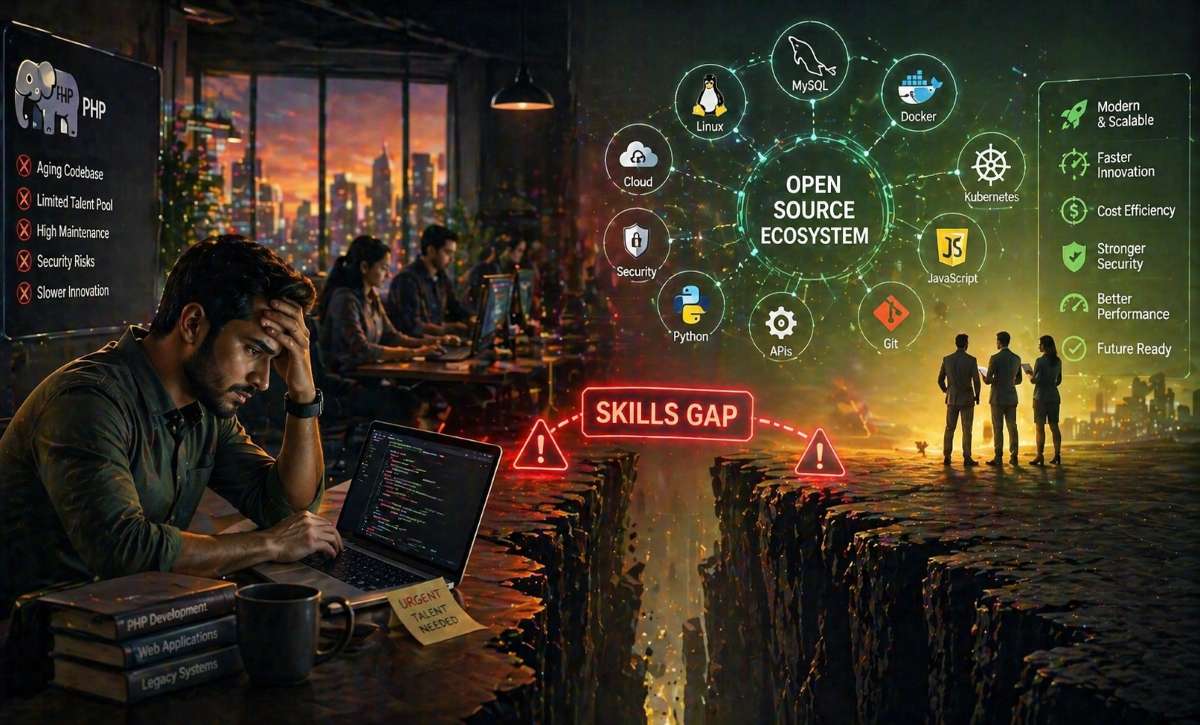
Financial services organisations relying on PHP-based systems may be exposed to rising operational and security risks, as new research points to a widening skills gap across the open source ecosystem.
According to the 2026 PHP Landscape Report from Perforce Software, PHP remains one of the most widely used programming languages globally, tying with JavaScript at the top of the open source stack. At the same time, adoption of open source software continues to accelerate, with 99% of organisations reporting they maintained or increased usage over the past year.
However, that growing reliance is increasingly undermined by a shortage of skilled talent.
Hiring pressures intensify
The report, based on responses from more than 700 open source users worldwide, identifies hiring as a leading challenge for organisations using PHP. Nearly a quarter (24%) of respondents cited a lack of personnel with the right skills and experience as a key operational issue, while for managers and directors it ranked as the number one concern.
The data also highlights a structural imbalance in the talent pipeline. More than half of PHP professionals surveyed have over 15 years of experience, while just 15% have five years or less, indicating fewer new developers are entering the ecosystem.
“This isn’t just a PHP problem. It’s an open source problem,” said Matthew Weier O’Phinney. “Organisations depend on PHP for mission-critical applications, but as experienced developers retire or move on, replacing that expertise is becoming increasingly difficult.”
Risk implications for financial services
For financial institutions, where PHP underpins a wide range of web applications, APIs and customer-facing platforms, the findings point to a growing disconnect between system dependency and available expertise. As firms continue to modernise legacy environments and roll out new digital services, the lack of skilled developers could create bottlenecks in system maintenance, upgrades and security patching—areas that are critical in highly regulated sectors.
This challenge is compounded by the complexity of modern application environments. The report shows PHP is rarely used in isolation, instead acting as a “glue language” across increasingly intricate stacks, integrating with databases, APIs and cloud-native infrastructure.
Modernisation continues despite constraints
Despite the talent shortage, organisations are continuing to invest in and modernise PHP environments. The report found that 76% of respondents are planning a PHP upgrade or migration, while 68% have already completed one in the past year.
At the same time, only 3% of organisations reported plans to retire PHP applications in 2026, reinforcing the language’s ongoing role in enterprise systems.
Investment across the open source stack also remains broad, spanning programming languages, databases, cloud and container technologies, and DevOps tooling—further increasing the demand for developers with full-stack expertise.
Balancing longevity with sustainability
The findings suggest a paradox for financial services and other enterprise sectors: PHP remains deeply embedded and operationally critical, yet the skills required to sustain it are becoming harder to secure.
“The takeaway… is pragmatic optimism,” Weier O’Phinney said. “PHP is here to stay. The challenge for organisations now is ensuring they have the skills, support, and continuity needed to sustain it for the long term.”
The full findings are available in the 2026 PHP Landscape Report.
For firms navigating digital transformation, the issue is less about replacing PHP and more about ensuring they can continue to operate, secure and evolve the systems that depend on it, at a time when experienced talent is increasingly scarce.
Sponsored content