

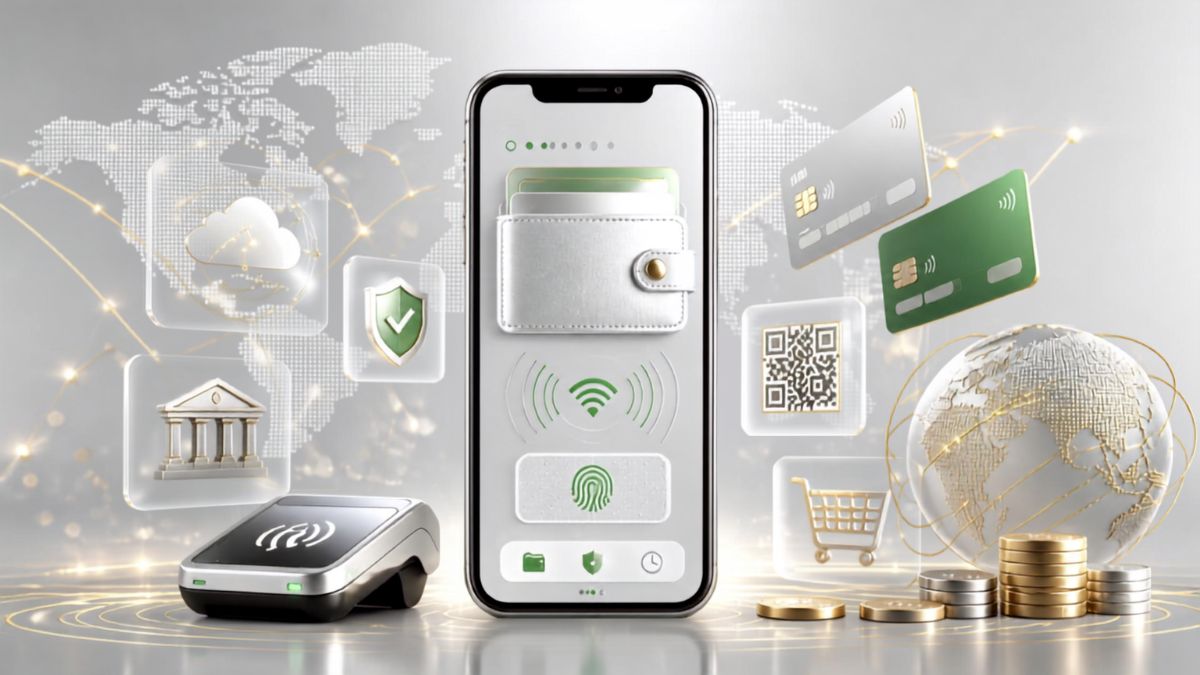
By Dmitrii Pshenin, Founder of Ligeniqo
Let’s go back for a while to the 2010s. In 2011, Google launched Wallet with NFC payment and it became a technological novelty as if something from the future. A smartphone could be brought to a terminal and a purchase could be paid for. At that moment nothing was clear yet, but it was already very interesting. A little later, in 2015, this function was improved and Google got Android Pay, and a year earlier, in 2014 – Apple Pay.
Yes, in those years the technology already existed, but it was far from widespread. The habit of contactless payment itself formed closer to the end of the decade, and a little later the pandemic only accelerated this process. If we break it down into numbers, then according to the European Central Bank, in the euro area in 2019, 41% of card payments at physical points of sale were contactless, and three years later this figure reached 62%. What had recently been a niche technology became an everyday habit.
What is hidden inside a digital wallet or why at the slightest mistake it loses its value in a second
Apple and Google made a kind of revolution in the world of payments, because the process itself for the user became many times easier. I emphasize, for the user. He brings his phone to the terminal, pays for his purchase and happily goes further about his business, completely not thinking about how many processes are happening between him and the seller.
And we come to the most interesting thing, digital wallets “won the first stage” and became loved by users precisely because of the interface and convenience. The user does not need to enter card details, receive a code by SMS message or somehow otherwise confirm the transaction, just brought it and paid.

However, a convenient interface wins only until the first error.
Behind every payment there remain many other participants in the process – the issuing bank, payment network, point of sale, terminal and so on. If the card is not supported and the payment does not go through, the user will not figure out what exactly happened and where the error occurred, his thought at this moment: “Apple/Google Pay did not work, okay”.
And here appears the next stage of the fight for the user – the product infrastructure, because it is exactly what determines quality. You can add even ten new functions to the app and with every payment give a soft toy, but if the user cannot pay for his coffee in his favorite coffee shop with contactless payment because something inside the infrastructure failed, then all the advantages will quickly stop mattering.
Here is a great analogy for you, if a restaurant has three Michelin stars, but the food there is not tasty for you, no titles of the chef will make you go there every day. Or like buying a car with an electric engine, but not having the possibility to charge it.
And a digital wallet works approximately the same way.
Its infrastructure includes adaptation to local markets, coverage of the market itself directly and stable work without those very failures. Generally speaking, two sides participate in the process – the buyer and the seller. For the first it is important that he can use contactless payment everywhere and always, for the second – that receiving money is fast, safe and economically justified.
One wallet – different markets
And here we move to the second interesting thesis – locality.
We are used to thinking that digital wallets are some kind of global product that exists everywhere, forgetting that payments themselves are tied to countries and their internal markets. That is, what works perfectly in one country may turn out to be useless in another.
Somewhere people are used to bringing a phone to a terminal, or phone to phone (which also exists on the market), for someone QR codes are more familiar. All this is different user habits that were formed for years and decades. And based on them it is impossible to simply take a successful model from country A and move it to country B.
Let’s use an example. Latin America, Argentina, here there is a boom in payments by QR code and instant transfers between accounts literally by nickname. Or let’s move to another part of the planet – Asia, China. Here the familiar payment scenario is also built around QR codes. The user especially strongly notices this locality exactly when crossing the border.
Let’s imagine a citizen of country X, where a global fintech works perfectly. A beautiful app, understandable interface, millions of users. He starts traveling and gets into a country where the main payment scenario is built around QR codes. At this moment the whole fintech turns into a pumpkin.
But okay, let’s suppose we solve this problem in the near future. What next?
The next stage of payment development, most likely, will also be inside the infrastructure, but even deeper. Instant payments, open banking, tokenisation and stablecoins will develop more actively. For the user these words, frankly speaking, are not important, just as it is not important how exactly and by what path the money went. The only important thing is that everything works. That is, inside the system becomes more complex, and outside, on the contrary, it should become simpler.
How to understand that a wallet really works
A logical question follows, what then should generally be considered success?
The number of downloads? Or maybe registrations? Will a million be enough? Or maybe three? Sounds beautiful, but by themselves these data say nothing. It is much more interesting to look at how many people really use the service regularly, what number of transactions they make, and also how often errors occur. The logic is simple: registrations show interest, and regular successful payments – that the product really works and is in demand.
And here we again return to infrastructure. Behind one digital wallet there are banks, payment systems, terminals, points of sale and dozens of other participants. The user does not see all of this, however the quality of their coordinated work is perceived by him as the quality of one specific service.
So probably, the best digital wallet is the one about the complexity of whose work the user will never know at all.